Label Description: Since the release of DAMAGED in 2024, Stuttgart-based producer Michael Fiedler aka GHOST DUBS has been surfing intensifying waves of adulation, finding himself praised regularly by such diverse underground legends as Justin Broadrick (Godflesh/Jesu), Regis, Stefan Betke (POLE), Steve Von Till (Neurosis), and others.
And now, with the release of Oblique, out 25th September on Kevin Martin’s imprint PRESSURE, his recognisable mastery of sculpting sound waves results in a spellbinding set of alien soundscapes. Larger in scale, richer in tone and certainly more cinematic, its cloudy abstractions and shadowy pulsations are no less hypnotic… in fact, probably even more so than its highly acclaimed predecessor. Lower, deeper and definitely moodier, Fiedler has upped his game by reaching further down into his own sonic void, conclusively proving that more ambient definitely doesn’t mean more boring. The appropriately titled 2nd album is a sublime collection of submerged rhythms and craftily blurred melodies. The album’s opener and single “Low Times” makes it glaringly apparent that Fiedler has pushed himself still further in terms of premium craftsmanship, in his relentless quest to extend heavy subterranean grooves and addictive narco loops. With atmospheric pressure pushed to the max, the track resembles a dream date for prime dirt-house-era Andy Stott and Berlin dub-tech pioneers Basic Channel, setting up the album’s heavy-lidded style and corroded sound entirely fittingly…
Across Oblique, Fiedler demonstrates his knack for crafting so much from so few component parts, seemingly becoming a maestro of minimalism. From the furtive balletic gyrations of “After All” and haunting ambience of “Soft Collapse” to the noirish atmospherics of “Blackout Dust” and the seriously chopped-and-screwed ghost of Jamaican reggae on “Bombed Suburbs”, the album moves between submerged rhythms, ambient noise and cinematic tension.
But perhaps what is most impressive about Oblique is that Ghost Dubs makes experimental music that is sensual, funky and literally stunning in its concussive impact, instead of being dry or alienating. Dense in the best possible sense, heavyweight without being punishing, it is the sound of dub techno if it burnt its own rigid rule book and was remixed by the spirit of DJ Screw.
By the time you reach the vaporous mist of album finale “Almost A Structure”, which sounds like KMRU jamming with Echospace, the realisation hits home that Oblique succeeds by navigating its own ultimate evaporation. Any obvious rhythm is craftily filtered out to leave a blurred and blunted residue, full of mystery and question marks. Much like the rest of this incredibly immersive record, it is a triumph of inferred narrative.
It should come as no surprise that Ghost Dubs, aka composer Michael Fiedler, recently scored the acclaimed arthouse film Sound of Falling. The film won the Jury Prize at the 2025 Cannes Film Festival and was selected as Germany’s entry for Best International Feature Film at the 2026 Oscars, subsequently making the shortlist.
Oblique is a future ambient classic that gets more compelling with every listen, illuminating Ghost Dubs revelling in the record’s own unrecognizability and delighting in plotting every elliptical detour. It is the sound of Ghost Dubs shedding his influences and making it 101% clear he has found his own sound.
Ken Li 2026
Produced : Ghost Dubs aka Michael Fiedler Mastered : Stefan Betke (Scape Mastering) Artwork/Photography : The Pathological Puppy
Label Description: Written and produced by Guy Gormley and Thomas Bush Additional production on Barley Wine by Theodore Wright Mastered by Miles Whittaker Dedicated to the Korg Triton.
CONDITION HUMAN (CNDHMN):You live in suburban Illinois. What is the most midwestern thing about you?
TIME RIVAL (TR):I grew up within one mile of the world’s largest corn maze
CNDHMN: Your album is titled ìCooked.î Care to explain? Are you a major foodie?
TR: Not really a foodie, no. I mean…I like food but I usually go for the simple things. Cooked, first and foremost, is some Gen Alpha slang. My son’s a pre-teen and into video games so he uses it in his vocabulary pretty regularly. I try to pepper it in when I talk to him just to be annoying. On top of that, though, it relates to the music because to me, this album has an over saturated, sun-bleached sound to it that connects the tracks together and makes it sound, well…cooked.
CNDHMN: Describe your journey to becoming a musician. Did you grow up in a household of music? Was it artsy? Were you always drawn to it or was it a later development?
TR: My parents aren’t musicians but they did expose me to different types of music. Listening was a big part of my upbringing, and allowing me to have my own musical tastes in my more impressionable years helped. I had a tape collection at 6 years old and a growing CD collection shortly after that. Any money I got as a kid went into buying CD’s.
I played trumpet in 5th grade band but it didn’t really interest me. My journey as a musician really started when I was around 14 years old and a friends’ older brother gave me a burned CD-R with some cracked music software on it. I taught it to myself and it really just grabbed my attention in a way nothing else did at the time. I decided to pursue music in college and played percussion in ensembles and orchestras. The engineering and production side was always more my speed though.
CNDHMN: You run the eclectic label Triplicate Recordings. Where’d the name come from and how does running it inform the music you make as Time Rival?
TR: There’s a little backstory here, in the early 2010’s I was invited to join an electronic music producer collective that we eventually called Mangled Music. There were about 12 of us ranging different styles. As the members started to lose interest and disband, I thought it would be cool to start a label with two of the artists in the group (George ìSuncastleî Ernst & Bryan ìBVSMVî Kraft) as a way to release our own music while sharing the workload. If you look back at the first year of Triplicate, all of the albums from 2018 come from the three of us. We picked Triplicate Records as a name because there were three of us, and it was a mildly amusing play on words.
As Time Rival, I record a seriously unnecessary amount of music and very little of it ends up on Triplicate Records. There are several other amazing artists that keep coming back to us and the release schedule is pretty limited, so I don’t want to take opportunities away from them because I decided to make 16 albums this year. I set aside music throughout the year that I think would be good for Triplicate and I squeeze myself into the schedule when I can.
CNDHMN: There’s a rumor you have a secret rap album as MC SOUTHSIDE MIKE called “MIC IT LIKE ITS HOT.” If false play it like it’s true. If true play it like it’s a terrible secret. So? (BONUS: your top 5 MC’s)
TR: Funny you should mention that, so I grew up listening to rap and very early on in my music production, I would find vocal stems of rap songs on file sharing services (this was pretty tough in the early days of the internet) and put them over weird beats I made. I certainly wouldn’t call it hip-hop, it was a very strange fusion. I lost all of those old recordings so I doubt they will surface any time soon.
Top 5 MC’s Andre 3000 (Outkast) Raekwon (Wu-Tang Clan) Guru (Gang Starr) Rakim (Eric B & Rakim) Black Thought (The Roots)
CNDHMN: Time to play “Desert Island Device!” You’re stranded on a desert island and you can bring one piece of electronic gear. Doesn’t have to b e musical even. What is it?
TR: This might be a cop out answer but I’d bring a field recorder. I’m currently using the Zoom H6 and I have a few of the different mics you can swap in, but the X/Y gets the job done. If I was going to take it to a desert island I’d probably upgrade to the newer versions with 32-bit float recording to bring down that noise floor.
CNDHMN: What’s the most ridiculously overpriced piece of high end stereo equipment out there?
TR: There are some vanity home theater setups out there that cost upwards of $5,000,000 and I’m guessing a blind A/B test with a $5,000 system would be too close to call. The technology now is all pretty good, even for budget stuff. If I really wanted to splurge on something I’d build my own open baffle kit. But I would need a bigger room for that.
CNDHMN: Do you have a specific approach to making music? Any thoughts or overarching ideas when you sit down or stand to play?
TR: It starts in my paper planner when I have “new music” written for the day. I do this three times a week. I don’t always come up with something usable but I usually do. If it’s in the schedule, I just sit down and do it. I work in a few different genres so I like to switch it up to keep things interesting. I draw inspiration from field recordings, books, music, movies, etc. Even if I’m not particularly inspired, once I start working the ideas start to flow.
CNDHMN: What were the instruments used on “Cooked?” Do you have a favorite?
“On 𝑹𝒆𝒕𝒖𝒓𝒏 𝒕𝒐 𝑴𝒂𝒅𝒂𝒅𝒆𝒏𝒊, Expugnantis brings to Enmossed a compendium of nine dubs of minimal, crystalline excellence. Reflecting on “foggy” memories of a long car ride from the uKhahlamba-Drakensberg portion of the Great Escarpment, the album texturalizes Expugnantis’s grainy sentimental remembrance. The aquatic production is filtered through cloudy synth pads and plucky percussion. Here the expanse sits in the gestures of the minimal, not hampering the listener with dense maximalism or dramatics, but evoking focus through precise and considered repetition.
While the rooting of the compositions is hypersomnic and sentimental, they are filtered through the geographical contexts of recording and operating in the isolatory confines within Columbia, South Carolina. The murk of the percussion is the architectural foundation for the recordings, the pivoting agent between what Expugnantis thinks of as the immersive aquatic field and the game of going within and out. Emotive but not cliche, driving but not oppressive; Expugnantis takes us to Madadeni or somewhere akin.”
– Nick Klein, June 2024
—
Marcus Mtshali is a producer and DJ based out of Columbia, South Carolina.
Recorded by Marcus Mtshali Audio and design finalized by Glyn Maier Interview by Rob Goyanes
The original concept for COUNCIL ESTATE ELECTRONICS was for Justin K Broadrick (Godflesh, Jesu, Final, JK Flesh, Techno Aniamal, Pale Sketcher) and Diarmuid Dalton, via analog synths and electronics, to pay tribute to the synthesizer music they were influenced by in their youth : Tangerine Dream, Throbbing Gristle, Kraftwerk, Cluster, etc. Set to the imagery and geography of the council estate in Birmingham in which they were both raised; Shard End and the surrounding areas. Once the duo set to work on the music they found other influences seeping in – seventies dub like King Tubby, Scientist, etc and early dub techno founders Basic Channel, Maurizio, Chain Reaction label, etc, thus expanding the sound palette and the geographical environment that was to be the theme for the project.
The Arktika, launched in St Petersburg, is the first of a new class of ships known as Type LK-60YA, ordered by Russian state nuclear agency Rosatom (eventually there will be three vessels). Its task will be to smash a path through the ice of the Northern Sea Route. Raw power counts for a lot in icebreaking, and by bringing 80,000 hp (60 megawatts) to bear, Arktika will be able to break through floating ice almost ten feet thick. The icebreaker will lead convoys along a route that otherwise would be impassable.
Justin K Broadrick: Electronics Diarmuid Dalton: Electronics
Produced by Justin K Broadrick Recorded at Avalanche and Djouce Justin K Broadrick is published by Mute Song Ltd.
Sleeve by Rutger Zuydervelt A Glacial Movements Records Release, October 2016. All rights reserved.
Release Dates Bandcamp Digital : 14th November 2025 Vinyl / Stream / Digital : 21st November 2025 There will be two editions of the vinyl… A ‘DINKED’ ltd edition on coloured vinyl with a free additional 12″ ft the extra digital tracks 13-16. And the standard edition which will ft tracks 1-12 on black double LP.
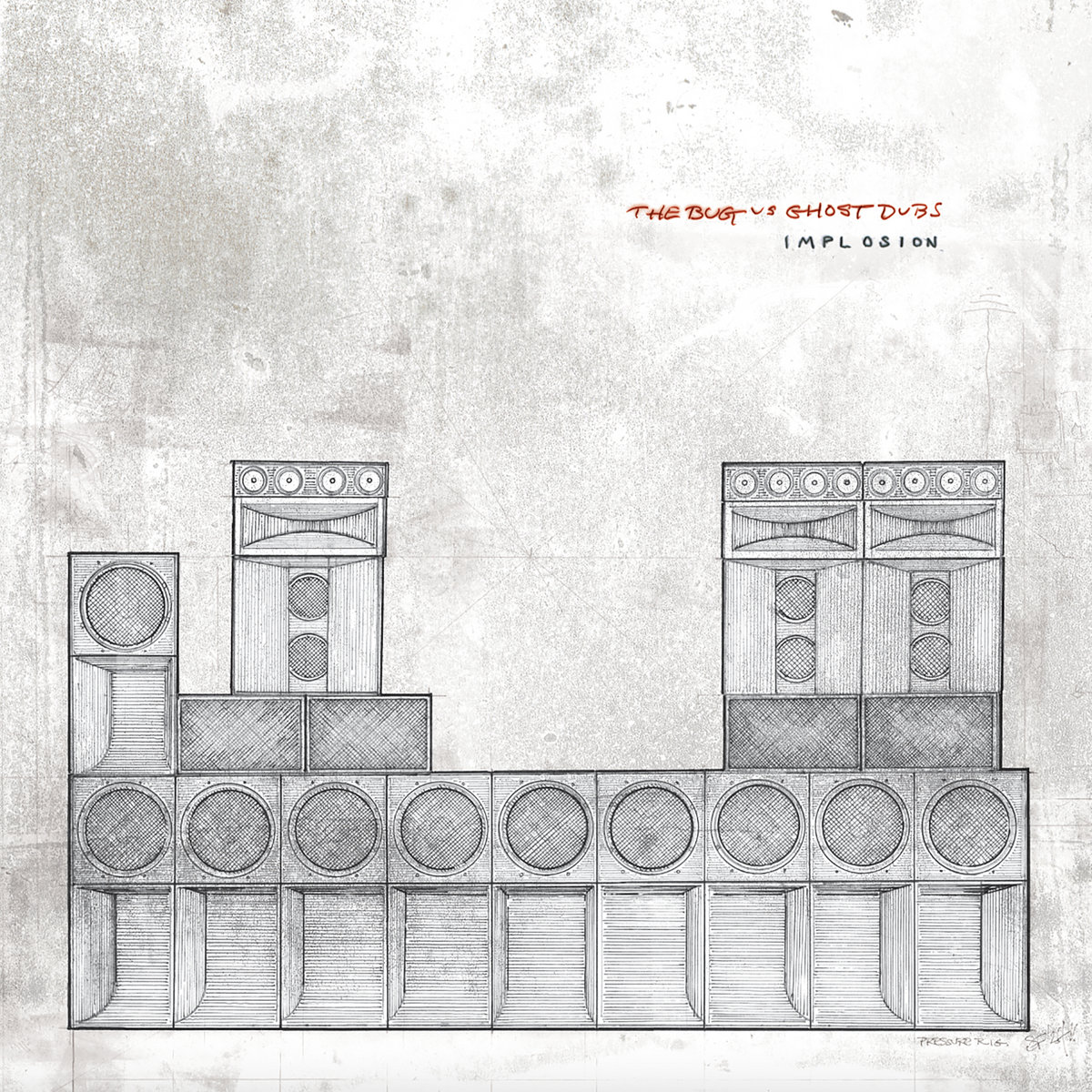
Press release : When Chuck D proclaimed “Bass, how low can you go?” on Public Enemy’s anthemic ‘Bring the Noise,’ maybe he was pre-empting or inciting the 10,000 fathoms-deep, spine-bending basslines and sub-quake tremors of ‘Implosion.’
Implosion is a crushing split album, appropriately released on The Bug’s own PRESSURE label. Mapping out a new form of spectral dub, the sound is deliberately immersive, introverted, and yes, definitely implosive. In pursuit of heavy lids, blurred vision, and merciless bass bin punishment, it’s one part meditation, two parts low-end theory, and essentially a confession of devoted sound system addiction.
As expected from a tag team featuring British soundlab explorer and ‘London Zoo’ composer Kevin Martin, aka The Bug, and Michael Fiedler, aka Jah Schulz—a long-time graduate of Germany’s new school of sound system reggae culture—the duo approaches their target differently yet share the goal of keeping their sound “raw” (Fiedler) and “brutally minimal” (Martin). This proves that opposites can attract, even if their tools are different and their methods sometimes diverge.
From such a disparate combo, hailing from different geographical and aesthetic backgrounds, contrasts are certainly on display, even within each artist’s own contributions. From the melancholia and transcendence of ‘Alien Virus (West Indian Centre, Leeds),’ to the duality of ascension and descension on ‘Hope,’ or the Sunn 0))) in dub, visceral drone of ‘Dread (The End, London),’ to the tripped-out repetitions of ‘Midnight,’ which reinvents Chain Reaction for post-millennials, the result is both sacred and narcotic. Each track illuminates the emotional impact and atmospheric pressure being explored across this deceptively sparse album—a mastery of tone and texture.
This collection might be as reduced, minimal, and deep as The Bug has ever gone, perhaps echoing the solemnity of his recent Kevin Richard Martin Black release and invoking the futurist steppas self-pioneered on his previous Pressure album. Alternatively, Fiedler‘s Ghost Dubs project ventures into his most heavyweight direction yet, which is no mean feat considering his previous, the critically acclaimed album Damaged, was a monstrously massive triumph of analogue weight and enviable sound design.
Implosion is ice-cool, a stark contrast to the warmth and sociability of traditional Jamaican roots and the current trends in digi-dub. Instead, the mood is soaked in tension and intense dread, finding an unexpected melting point where classic dub’s stark rhythm attack, isolationist ambience’s eerie drift, dub techno’s floatation strategies, and even the relentless riffs of doom metal collide. As the bass-obsessed pair drop what is arguably the heaviest ambient dub album to emerge from any electronic sector—a moody counterpoint to The Orb’s fluffy clouds, etc, Martin has cited The Roots Radics, Black Jade, and On U Sound’s Pounding System as heavily influencing his approach to the album, while Fiedler has expressed his admiration for Adrian Sherwood’s productions and Rhythm & Sound’s enchanting soundscape. Yet, the super heavyweight pulsations, emotive resonances, and bone-rattling vibrations detonated here effortlessly go far beyond these influences.
Shadowy and elusive, there’s a mysteriousness at this record’s core. A haunting moodiness oscillating between nostalgia and future shock. Despite the deadly fixation with SLOW and HEAVY, the album maintains a totally hypnotic swing throughout. Implosion and its lead single ‘Imploded Versions’ are testaments to being enveloped in bass, seduced by bass, submerged in bass, and utterly crushed by bass, as The Bug and Ghost Dubs seek to craft a new form of dub for zonal headz and Babylon seekers.
Mastered by Stefan Betke (a.k.a. POLE) at Scape Mastering studio, this record is heavy as f-ck without resorting to continuous distortion. It’s low-end worship taken to an absolute extreme, yet remains highly listenable and definitely danceable, albeit at the slowest of paces. Sacred and narcotic, this is low-end worship amplified to the max. Dive in if you dare.
As The Bug, Kevin Martin’s music is built from an overwhelmingly explosive sub-bass pressure, with relentless in-the-red beat production that amplifies mutant industrial sound design, fuzzed, expectant crackle, and bleak greyscale harmonics. Over decades of diverse and storied projects and releases, Martin has earned a reputation as a subverter of expectations. In 2008 – after his gritty, tumultuous album London Zoo, where he and his long-term collaborator Flowdan delivered the instant classic ‘Skeng’ – he unexpectedly formed the new trio King Midas Sound, whose mix of spoken word poetry and Japanese-language vocals (performed by British-Trinidadian dub poet Roger Robinson and WaqWaq Kingdom’s Kiki Hitomi, respectively) created a storytelling approach new to his work. Further collaborations followed as his range and output grew. He worked with long-established experimental composer Fennesz, post-metal pioneers Earth, and even the rarefied, mournful drone-folk of solo artist Grouper, each bringing new dimensions to his sound. In 2019, after the trauma of his son’s problematic birth, he abandoned all aliases and released Sirens, a deeply emotional exploration of dread and paternal love set in the most isolated ambient territory, winning rave reviews.
Michael Fiedler gained international recognition in 2024 with the Ghost Dubs album Damaged, released on The Bug’s own PRESSURE label. The Stuttgart-based artist crafted a wholly original fusion of low-end pressure, live dub techniques, and industrial sound aesthetics which, although inspired by traditional dub/roots, dub techno, and even shoegaze or drone, captured many listeners’ attention with Fiedler’s futuristic sound design and mesmerising, slo-mo dubbed gyrations. Previously known and established under his alias JAH SCHULZ, he is a graduate of Germany’s vibrant dub/reggae sound system scene. It was through that scene that he first released international records, performed at festivals, and developed legendary live dub shows where he began rearranging tracks in real time. Under the name JAH SCHULZ, he founded and co-owned Infinite Density Records and released music on various other labels, including Echo Beach, Green King Cuts, and Basscomesaveme. He also gained support from major international sound systems such as Iration Steppas, King Shiloh, Jah Shaka, and Blackboard Jungle, who regularly feature Jah Schulz tracks in their sets.
Ken Li 2025
released November 21, 2025
Music / Production : The Bug tracks : The Bug (Kevin Richard Martin) Ghost Dubs tracks : Ghost Dubs (Michael Fiedler)
Mastered : Stefan Betke (Scape Mastering)
Artwork : Simon Fowler Gatefold inner photography : Eric Audoubert
A deep reworking of Llyn Y Cwn’s “Megaliths” (2024). The original was a profound dark ambient exploration of the sacred resonance embedded within stone circles; “Megaliths In Dub” is the echo beneath the surface, the unheard rhythm that has always been there.
The megaliths stand – timeless, unyielding. Their histories stretch beyond recorded memory, their presence imbued with silent narratives of the land. “Megaliths” sought to channel this ancient energy into pure sound. Yet no history exists without its counterpart – no creation without its shadow.
On “Megaliths In Dub”, suppressed tempos emerge, pulsing with the primal force of forgotten rites. Guitar invocations from the live rituals weave through the fabric of the album, distorting and reshaping the familiar, exquisite dark ambient Llyn Y Cwn has become renowned for.
It is a sonic metamorphosis – a spectral reflection of the megalithic presence.
The stones have been disturbed.
Presented in a 6-panel digipak with breathtaking photography by the artist.
Music & Photography: Benjamin Ian Powell Mastering: Martin Bowes Layout Remix: Abby Helasdottir
…………………………………………..
LLYN Y CWN “Megaliths” (2024).
Megaliths (2024) was a sonic pilgrimage through burial chambers and stone circles, crafted from years of field recordings and convolution reverbs. Guided by Julian Cope and Aubrey Burl, Llyn Y Cwn channelled the ancient silence into immersive dark ambient soundscapes.
coldspring.bandcamp.com/album/megaliths-csr334cd
ALBUM LAUNCH + CONCERT:
LLYN Y CWN play Unitarian Church, 3pm Saturday 11th Oct at Harmonicon Festival, Tordmorden – with The Transcendence Orchestra (Surgeon and Dan Bean), Bridget Hayden, David Keenan…
LLYN Y CWN conveys atmosphere and environment through deep ambient sounds. A phantasm of echoes reflecting the bleak majesty and poetic melancholy of the hinterland of North Wales. A hole within a void, a place defined by absence in a world of negative space.
Ben Powell has been making electronic music for over 25 years, drawing inspiration from his native North Wales landscape and his participation on Arctic research cruises. While most artists can only imagine what these desolate land and seascapes feel and sound like, Llyn Y Cwn is an authentic reflection of these incredible locations.
The leading black light of OUTDUSTRIAL music, Forgotten Sunrise, have put together a comprehensive remix album of their LP elu. With 21 versions from their closest allies, the album’s timeless tracks are given multiple re-envisionings, yielding many new moments of musical delight across the board. Estonia’s most legendary unquantifiable band have added another piece to their still flourishing discography, striking further into the realms of the unknown.
Purchase also includes code to original full length album!