Label Description: I’ve not thought about Psychick Youth for a long time, the anti cult cult, but the reality is I had a great time and met a lot of good people, many of whom I’m still in touch with. Left in the hands of others who just weren’t there, people jumped on the gravy train and ultimately failed to answer any questions. Failed books and failed documentaries followed, where the main priority seemed to be taking the money and hoping for the best.
The press described it as: “Thee Temple Ov Psychick Youth, or TOPY, emerged from Britain’s industrial underground as a strange mix of occult network, performance art project and countercultural movement. Closely tied to Psychic TV and Genesis P-Orridge, it blurred the lines between music, ritual, media manipulation and social experiment. The press often struggled to define it, describing TOPY as everything from an anti cult to an anarchic art movement built on sigils, tape culture and radical ideas about identity and consciousness. Its use of ritual imagery, underground publishing and global ‘access points’ helped build an air of mystery that fed years of fascination and controversy. Writers frequently linked the group to figures such as Aleister Crowley and William S. Burroughs, placing it in a lineage of artistic and cultural disruption. Decades later, TOPY is still seen as one of the most provocative and influential movements to emerge from post industrial Britain.”
That’s about as close as most people got, but we were on the inside and were the ones who eventually closed it down. The mission is indeed terminated.
Label Description: The music that was available this week manifested as something gentle and generous. There are some complexities in the upper partials of some notes, particularly as they interact with other higher notes, but the vibe here is very approachable. Timbres have a lot of breath in them, sounding a bit like reed instruments (bassoon, accordion), as well as the flute family. There’s plenty of space, and consideration for listeners joining us on this journey. It’s a good reintroduction to the home-built Res-O-Glas and this series.
Sending best wishes and oscillations to everyone listening, particularly for anyone facing challenges.
The titles this week are references to the visual art of Verena Bachl. Thank you for listening!
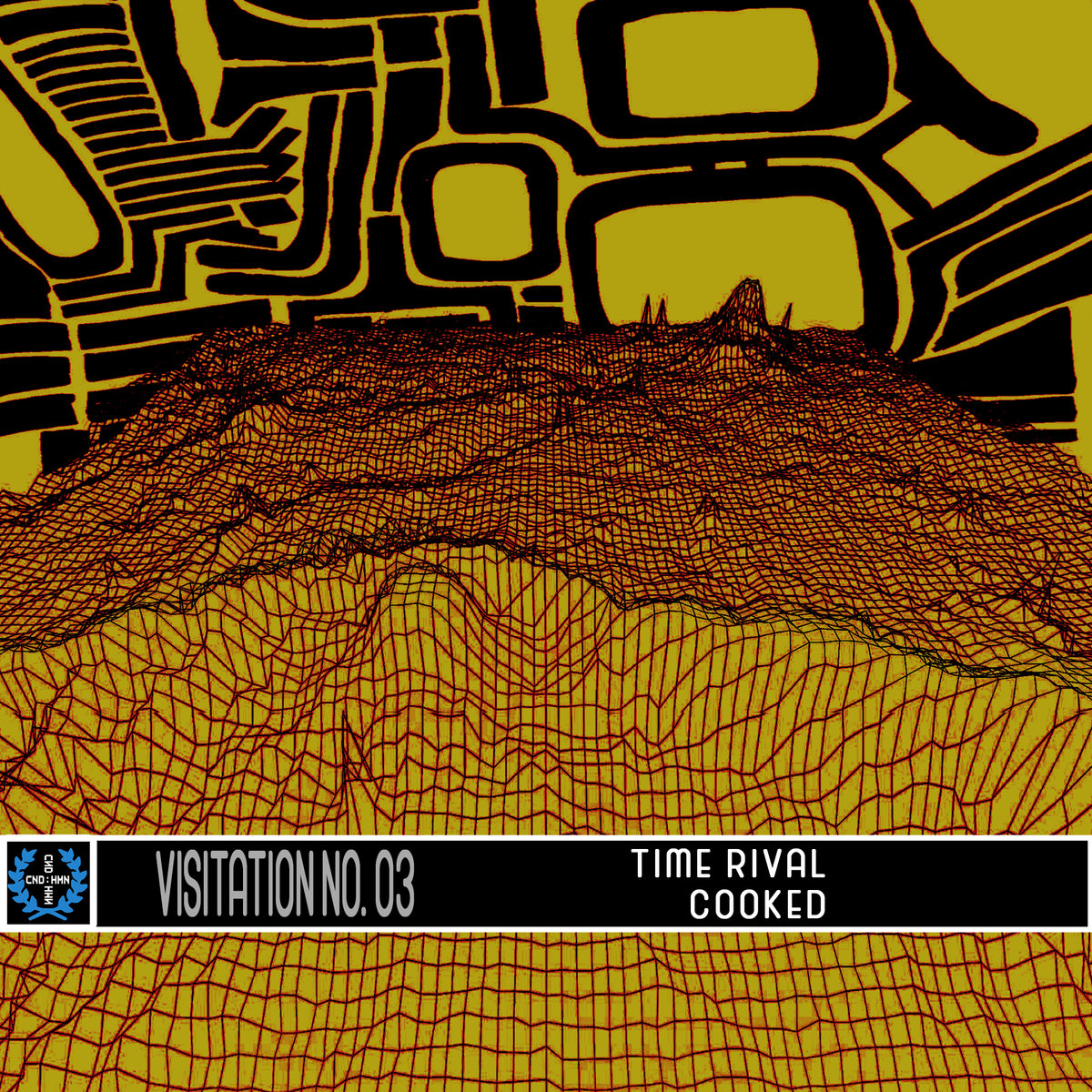
CONDITION HUMAN (CNDHMN):You live in suburban Illinois. What is the most midwestern thing about you?
TIME RIVAL (TR):I grew up within one mile of the world’s largest corn maze
CNDHMN: Your album is titled ìCooked.î Care to explain? Are you a major foodie?
TR: Not really a foodie, no. I mean…I like food but I usually go for the simple things. Cooked, first and foremost, is some Gen Alpha slang. My son’s a pre-teen and into video games so he uses it in his vocabulary pretty regularly. I try to pepper it in when I talk to him just to be annoying. On top of that, though, it relates to the music because to me, this album has an over saturated, sun-bleached sound to it that connects the tracks together and makes it sound, well…cooked.
CNDHMN: Describe your journey to becoming a musician. Did you grow up in a household of music? Was it artsy? Were you always drawn to it or was it a later development?
TR: My parents aren’t musicians but they did expose me to different types of music. Listening was a big part of my upbringing, and allowing me to have my own musical tastes in my more impressionable years helped. I had a tape collection at 6 years old and a growing CD collection shortly after that. Any money I got as a kid went into buying CD’s.
I played trumpet in 5th grade band but it didn’t really interest me. My journey as a musician really started when I was around 14 years old and a friends’ older brother gave me a burned CD-R with some cracked music software on it. I taught it to myself and it really just grabbed my attention in a way nothing else did at the time. I decided to pursue music in college and played percussion in ensembles and orchestras. The engineering and production side was always more my speed though.
CNDHMN: You run the eclectic label Triplicate Recordings. Where’d the name come from and how does running it inform the music you make as Time Rival?
TR: There’s a little backstory here, in the early 2010’s I was invited to join an electronic music producer collective that we eventually called Mangled Music. There were about 12 of us ranging different styles. As the members started to lose interest and disband, I thought it would be cool to start a label with two of the artists in the group (George ìSuncastleî Ernst & Bryan ìBVSMVî Kraft) as a way to release our own music while sharing the workload. If you look back at the first year of Triplicate, all of the albums from 2018 come from the three of us. We picked Triplicate Records as a name because there were three of us, and it was a mildly amusing play on words.
As Time Rival, I record a seriously unnecessary amount of music and very little of it ends up on Triplicate Records. There are several other amazing artists that keep coming back to us and the release schedule is pretty limited, so I don’t want to take opportunities away from them because I decided to make 16 albums this year. I set aside music throughout the year that I think would be good for Triplicate and I squeeze myself into the schedule when I can.
CNDHMN: There’s a rumor you have a secret rap album as MC SOUTHSIDE MIKE called “MIC IT LIKE ITS HOT.” If false play it like it’s true. If true play it like it’s a terrible secret. So? (BONUS: your top 5 MC’s)
TR: Funny you should mention that, so I grew up listening to rap and very early on in my music production, I would find vocal stems of rap songs on file sharing services (this was pretty tough in the early days of the internet) and put them over weird beats I made. I certainly wouldn’t call it hip-hop, it was a very strange fusion. I lost all of those old recordings so I doubt they will surface any time soon.
Top 5 MC’s Andre 3000 (Outkast) Raekwon (Wu-Tang Clan) Guru (Gang Starr) Rakim (Eric B & Rakim) Black Thought (The Roots)
CNDHMN: Time to play “Desert Island Device!” You’re stranded on a desert island and you can bring one piece of electronic gear. Doesn’t have to b e musical even. What is it?
TR: This might be a cop out answer but I’d bring a field recorder. I’m currently using the Zoom H6 and I have a few of the different mics you can swap in, but the X/Y gets the job done. If I was going to take it to a desert island I’d probably upgrade to the newer versions with 32-bit float recording to bring down that noise floor.
CNDHMN: What’s the most ridiculously overpriced piece of high end stereo equipment out there?
TR: There are some vanity home theater setups out there that cost upwards of $5,000,000 and I’m guessing a blind A/B test with a $5,000 system would be too close to call. The technology now is all pretty good, even for budget stuff. If I really wanted to splurge on something I’d build my own open baffle kit. But I would need a bigger room for that.
CNDHMN: Do you have a specific approach to making music? Any thoughts or overarching ideas when you sit down or stand to play?
TR: It starts in my paper planner when I have “new music” written for the day. I do this three times a week. I don’t always come up with something usable but I usually do. If it’s in the schedule, I just sit down and do it. I work in a few different genres so I like to switch it up to keep things interesting. I draw inspiration from field recordings, books, music, movies, etc. Even if I’m not particularly inspired, once I start working the ideas start to flow.
CNDHMN: What were the instruments used on “Cooked?” Do you have a favorite?
Label Description: no one remembers when the first false wind stirred, nor a time before their song began. as the still of night soothes our slumbering valley, the first crackle of embers sways in the shadow of elm and willow. atop a bed of deadened bark comes the hiss of a breeze that disturbs not the canopy above, nor does it wick the salt from one’s skin. here does coloured dust swirl against the darkness, and the first hollow, melancholy chime ring out
i close my eyes and recall the flavour of scorched ash and a hint of her favourite mango bubblegum sweetening the filter of the cigarette we passed between us. laid upon the roof of our car, staring ever upwards awaiting the lanterns of the past’s nightporters to decorate the sky. always caught mid-laugh by the sounding of the lambent bells off in the distance, though hardly ever in any hurry to make ourselves their audience. not while we had a fool’s infinity to spare
sunken notes whistle through the abandoned woods. the lights of every promised yesterday glows upon my lidded eyes. i feel a dim, charred flake at my lip. i wish for it to taste of mango. this desire is enough to alert me once more to my sense of the present, and my eyes would draw open to a flurry of cinders as a bellow strikes deeply into the air. i step into the cloud of dim flickers, and listen to its cry wavering into the ink-black eternity as it fizzles away
within my chest, a sigh begs. yet i remain silent, lest my pained breath mask the warm tone of her voice. each night unmoored between the blooms may i remain, until i find her among the glittering chorus of the gone
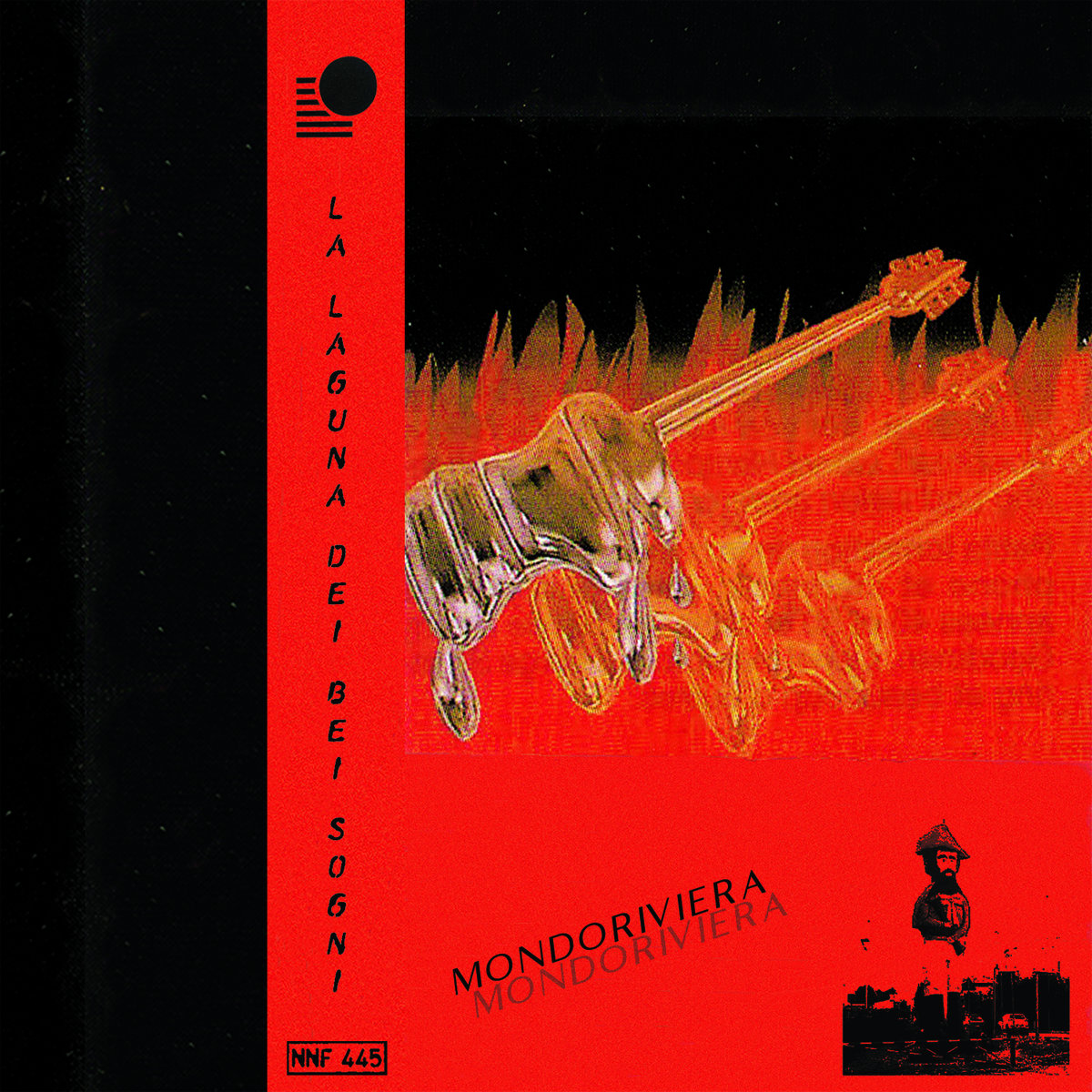
Label Description: The latest by Rimini riddler Lorenzo Camera aka Mondoriviera refracts his burnt vapor mutant sound design into a melted palette of hypnagogic guitar, funhouse keys, wormhole FX, and narcotic crooning: La Laguna Dei Bei Sogni (“The Lagoon of Beautiful Dreams”). Inspired by an episode of a 70’s Italian cartoon about a fugitive ex-army officer delirious with yellow fever on a paradisal South American island surrounded by stolen money and perplexed indigenous villagers, the songs stir an appropriately manic and hallucinatory mood.
Layers of guitars and voice sway and surf in a smog of memory and melody, punched up with curveball rompler samples (metallic percussion, monster growls, UFO sirens), then processed through a cheap Zoom FX pedal to tie it all together. The result is a hazy alien odyssey of fever dream pop, flashback glam, and lo-fi teleportation, rippled by sunset breezes across the Adriatic.
Mastered by Jared Carrigan. Design by Britt Brown.
Label Description: In spring 2025, Abul Mogard and Rafael Anton Irisarri created the source material for their second album, Where Light Pauses in the Silence of the Sun, during a three-day residency at Morphine Raum in Berlin. Functioning as both recording studio and performance venue, the space has no stage, with the audience gathered around the performers. Working within an open framework, the duo reshaped the music each evening while recording the performances live to multitrack. Rotary speakers, modular synthesizers and bowed guitar formed the core of their sonic language, captured through a 1970s mixing console and microphones placed around the room.
Back in Mogard’s studio in Rome, the material was further crafted as motifs were stretched, fragments isolated, and tempos dissolved. Irisarri recorded additional guitar textures and treatments in New York, while passages recorded by Martina Bertoni and Andrea Burelli in Berlin reinforced the harmonic centres and brought breath, refinement and a new sensibility to their compositions. The process continued as Mogard’s layering and subtraction reassembled everyone’s parts into the final arrangement.
The album opens with “In the Eastern Wild,” building from a sparse outline into a monumental formation of low-frequency weight, its internal motion shaped by the rotating Leslie speaker. “Over the Domes” widens into a broader acoustic field, where sustained modular tones meet waves of softly plucked guitar. The music then turns inward with “A Blue Descent,” centred on Bertoni’s cello, whose growling timbre introduces a melancholic depth.
At the album’s centre, “In a Quiet Radiance” unfolds around a slow guitar ostinato, its luminous stillness opening into a more expansive and reflective state. Across its ten-minute span, Burelli’s violin lines and Bertoni’s lower cello phrases gradually surface, weaving through the harmonic field. Mogard brings Burelli’s processed voice to the fore, its emotive, operatic presence becoming one of the record’s pivotal moments. “Of Blessed Ages” suspends the sonic flow, shifting between parallel major and minor chords as lingering, slowly decaying melodies shape the music’s internal drift. The closing “Among Shadows” settles into a darker resonance as layered textures recede.
Mogard and Irisarri’s shared language balances restraint and maximalism. UK magazine Crack describes the music as “a tidal wave held in suspension,” while Dutch newspaper de Volkskrant writes, “What a colossal sound, and how this music strikes at the emotions.” Reflecting on the residency sessions, Irisarri recalls: “At moments I genuinely couldn’t tell if a sound was coming from me or from Abul. It stopped feeling like two people making decisions and began to feel like we were inside a system moving on its own.”
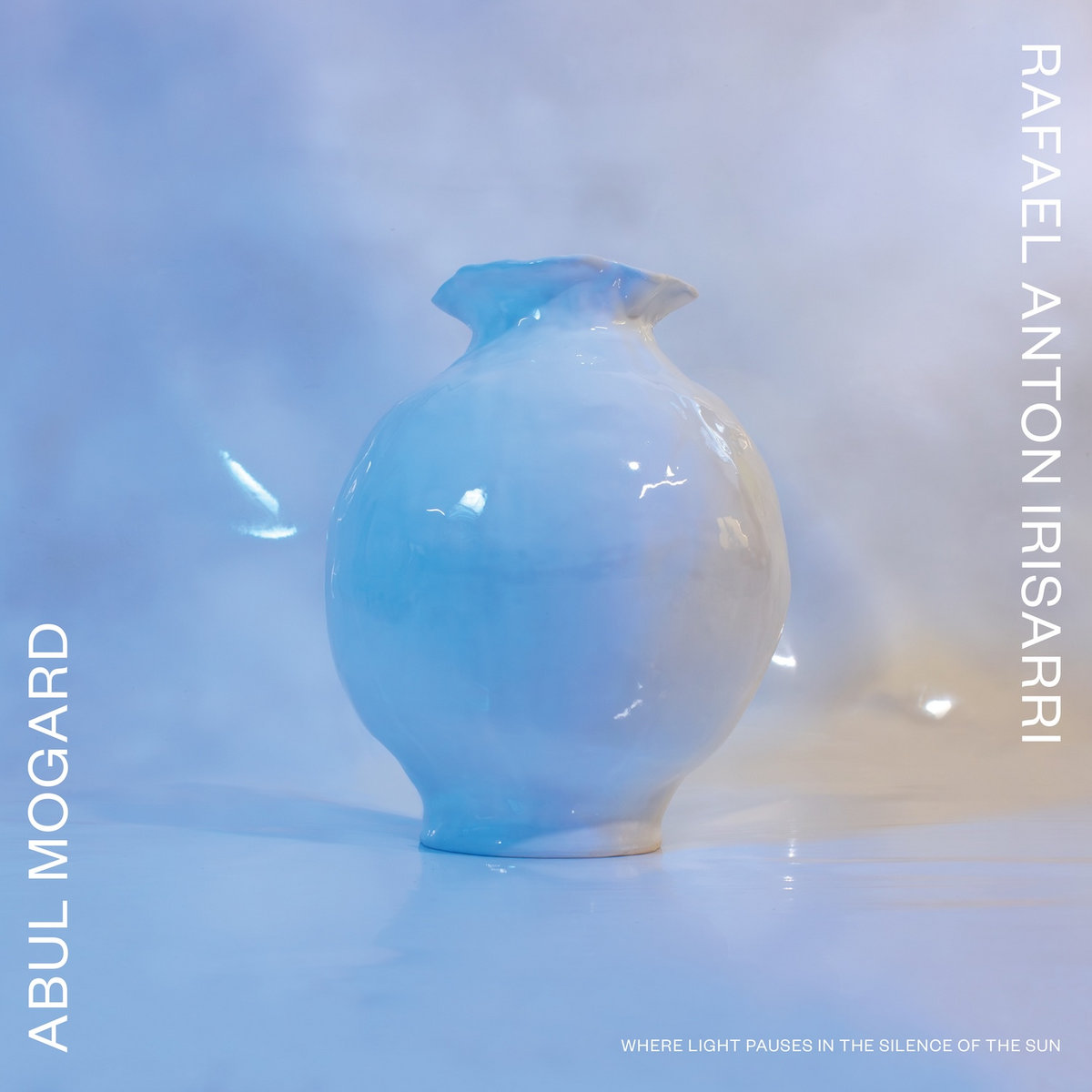
Marja de Sanctis’ cover artwork revisits the vessel sculpture from the duo’s first album, Impossibly Distant, Impossibly Close. There it appeared as raw, unfired clay. Here it has been fired in the kiln and finished with a glaze. Light gathers on its polished surface and spills into the surrounding space. As she explains, “I wanted to convey the idea of continuity within the duo, and the vessel became a kind of container for that idea. However, their music felt different this time, and with the collaboration of Martina and Andrea, I felt it should have a sleeker, softer, more glamorous look, very distant from the first raw appearance.” The transformation of the vessel from raw clay to fired form suggests a passage from immediacy toward permanence, mirroring the music’s gradual expansion.
Abul Mogard: synthesizers, treatments Rafael Anton Irisarri: electric guitars, Leslie speaker, treatments Martina Bertoni: cello on “A Blue Descent” and “In a Quiet Radiance” Andrea Burelli: violin and vocals on “In a Quiet Radiance”
Composed and produced by Abul Mogard and Rafael Anton Irisarri.
“A Blue Descent” composed by Abul Mogard, Rafael Anton Irisarri, and Martina Bertoni.
“In a Quiet Radiance” composed by Abul Mogard, Rafael Anton Irisarri, Andrea Burelli, and Martina Bertoni.
Recorded by Rabih Beaini and Lucas Brell during a residency at Morphine Raum, Berlin, 18–20 March 2025. Transformations and overdubs completed in Rome, New York, and Berlin, Summer 2025. “Of Blessed Ages” recorded by Abul Mogard in Rome. Additional recordings by Andrea Burelli and Martina Bertoni in Berlin.
Mixed by Abul Mogard in Rome, September–October 2025. Mastered by Stephan Mathieu at Schwebung, Bonn. Lacquer cut at Schallplatten Schneid Technik (DE). Pressed on BioVinyl at Optimal (DE).
Artwork by Marja de Sanctis Photography advisor: Alessio Pizzicannella Design and layout by Daniel Castrejón
Made in Germany
Many thanks to: Alessio, Daniel, Karen, Iulia, Marja, Matze and everyone at Morr Distribution, Stephan, all our friends and family.





 Music For The Rest Of Us