
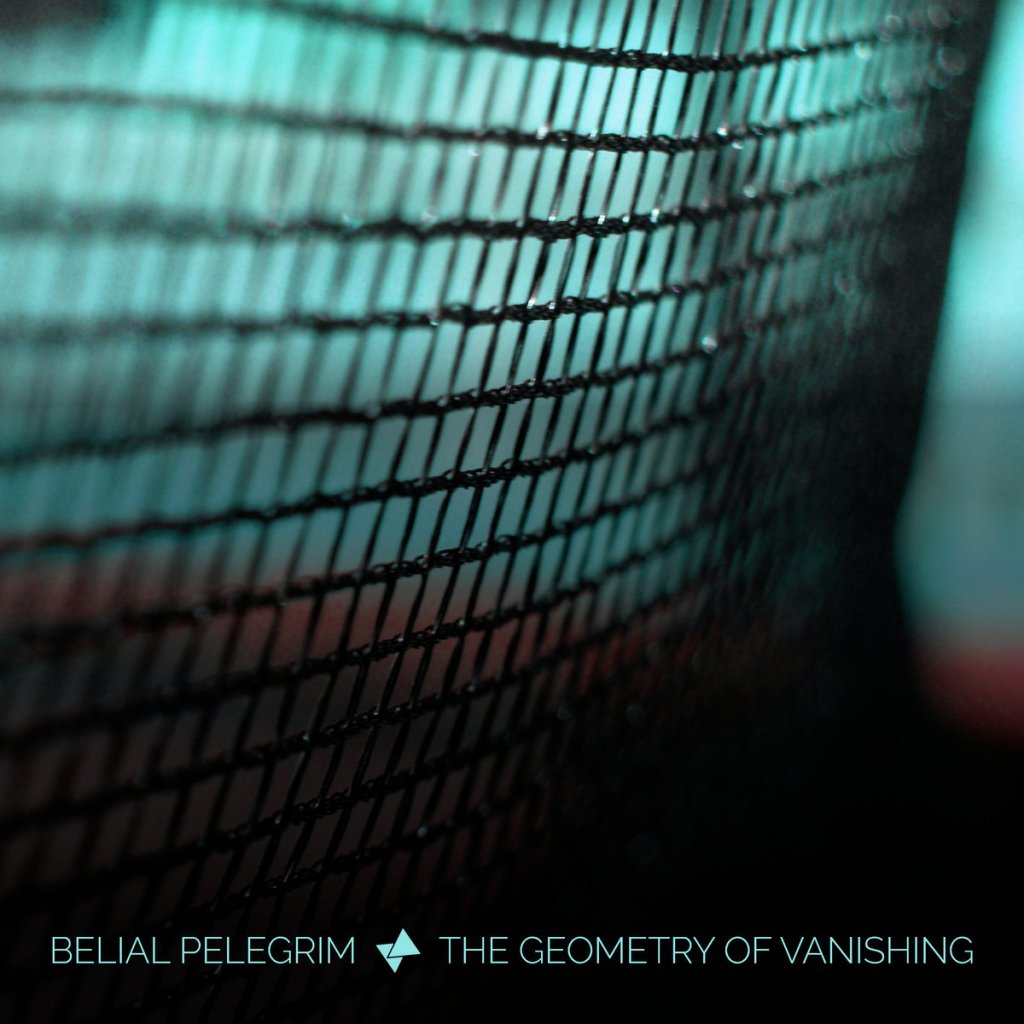
Label Description: AVAILABLE ON CD & VINYL:
elasticstage.com/triplicate/releases/the-geometry-of-vanishing-album
Belial often delights in making murky and foreboding tones, but he’s just as good at revelling in the prettiness this world still has to offer. This could not be more evident anywhere else but on this sprawling and spectacular selection of songs.
__________
INTERVIEW
__________
Triplicate Records: How have you been? What’s new in Belialand?
Belial Pelegrim: I’ve been really good. Like most of the time, I’m trying to find that balance between life itself and the amount of creative work I always seem to want to be doing. I recently got back from a vacation in Fort Bragg, California, and being near the ocean always resets something in me. It has a way of clearing out the mental noise and putting things back into perspective. I usually come away from it feeling renewed, both personally and creatively.
TRIP: We’ve spoken in the past about your lengthy and ambitious projects and how long they can take to come together; was this one of those ‘oh my gosh this is taking forever’ type dealies?
BP: Well, after TAFFETA, almost anything is going to seem like a short-term project! That was five years of releasing a new chapter every week, so it definitely recalibrated my sense of what “taking forever” means.
This new album came together differently. For about a year I had been working on music and deliberately setting certain pieces aside because I felt they belonged to something larger. I didn’t necessarily know exactly what that larger thing was going to be at first, but I knew I didn’t want to just release everything individually as soon as it was finished. I wanted to let a body of work accumulate and see what relationships started to emerge between the pieces.
I kept in touch with Mike during that time, and once I reached a point where I could stand back from the material and hear it as a complete thing, I contacted him and said, essentially, “I think I have something for Triplicate.” So this one never really had that oh my gosh, is this ever going to end? feeling. It was more like slowly filling a room with objects and eventually realizing they all belonged in the same room.
TRIP: If you could only eat one meal for the rest of your days, what would it be? Disregard health concerns. Let’s just say it’s magically healthy.
BP: My love of Mexican food knows no bounds, so this one is actually pretty easy: birria tacos. If we’re operating in a magical world where health concerns no longer apply, I’m fully prepared to make that commitment. Give me good birria, some consommé on the side, and I think I could live with the consequences.
TRIP: What’s your favourite title? There’s some bangers here; I particularly enjoy “Instructions found under Ice”.
BP: Part of the fun of making mostly instrumental music is coming up with the titles. Sometimes a title comes first and I end up writing toward it, or at least toward some vague idea or atmosphere it suggests. Other times the music is already there and the title arrives afterward. It really varies from track to track.
On this album, I do love Instructions Found Under Ice. That one has a nice mystery to it. I’m also really fond of The Hallway Had Other Plans and We Traveled the Lake in Sections. I like titles that feel as though they’re pointing toward a story without actually telling you what the story is.
I’ve also always felt that titles and cover art are part of the invitation into the music. With instrumental work especially, those things can give someone just enough of a doorway to become curious. The right image paired with the right title might be what gets somebody to press play in the first place, and then hopefully the music takes over from there.
TRIP: Read any good books lately?
BP: Absolutely. I spent quite a bit of time with Mark Z. Danielewski’s House of Leaves, and it really got its hooks into me. It’s one of those books where saying what it’s “about” almost immediately starts reducing it. On the surface there’s this impossible house that’s larger on the inside than the outside, the Navidson expedition into it, layers of narrators and documents and footnotes, and then the physical book itself begins behaving almost like another character. Words move around the page, disappear, become isolated, turn sideways—you eventually stop simply reading it and start physically navigating it.
What fascinated me most wasn’t necessarily the horror in the conventional sense. It was the spatial problem. I kept wondering: where are those hallways actually going? Where does that enormous black interior exist? I know the house can very easily be read as trauma, grief, relationships, the unconscious, all of those things—and I think all of those interpretations are valid—but I was reluctant to completely surrender the literal possibility. I liked entertaining the idea that the space is actually there, that it’s somehow extra-dimensional, or outside our normal understanding of location and time.
And creatively, the book definitely followed me out of the reading experience. I even started working on music inspired by some of those ideas. That’s usually the sign that something has really affected me—when I stop thinking about it simply as a book, film or piece of art and it starts infecting the way I think about my own work. House of Leaves absolutely did that.
TRIP: Can you talk a little bit about the hardware (or software) used to make The Geometry of Vanishing?
BP: I use a lot more software than hardware these days. For one thing, I like the fact that I don’t have to dust it. Seriously though, Ableton Live is really the center of everything for me. From there I use a ridiculous variety of third-party instruments, soft synths, effects and Max for Live devices. I don’t tend to build tracks around one particular piece of software; I’m much more interested in combining things that weren’t necessarily designed to live together and seeing what happens.
Off the top of my head, some of the things that showed up on The Geometry of Vanishing were Pigments, Myth, some homemade Reaktor synths, Kontrast, Abyss, Phona, Outgrowth, SketchCassette II, Buchla Easel V, Falcon, and various Spitfire and Vienna libraries. A lot of Slate + Ash instruments and I also used quite a few Max for Live devices inside Ableton for sequencing, modulation and generative processes.
So the software changes constantly, and I’m always finding some new instrument or strange little device to throw into the mix. The specific tools are important, but ultimately I’m much more interested in what happens when you start misusing them, combining them, and allowing them to lead you somewhere you weren’t necessarily planning to go. And as usual, I also employ a combination of real instruments; electric and acoustic guitars, drums, and upright bass when needed.
Composed & Produced by Scott Krakoff
Mastering by Michael Southard
Artwork by Michael Southard

